
Does our unconscious mind really hold hidden desires, impulses, and urges? Does our mind protect us from these? What does the research say? Let’s talk about it!
If you’re familiar with Sigmund Freud, you’ll know he’s considered the father of psychology. His theory of the id, ego, and superego is often taught to psychology students. But before that theory, he had another. It was called the topographical model, which was a way that Freud thought about how the personality develops.
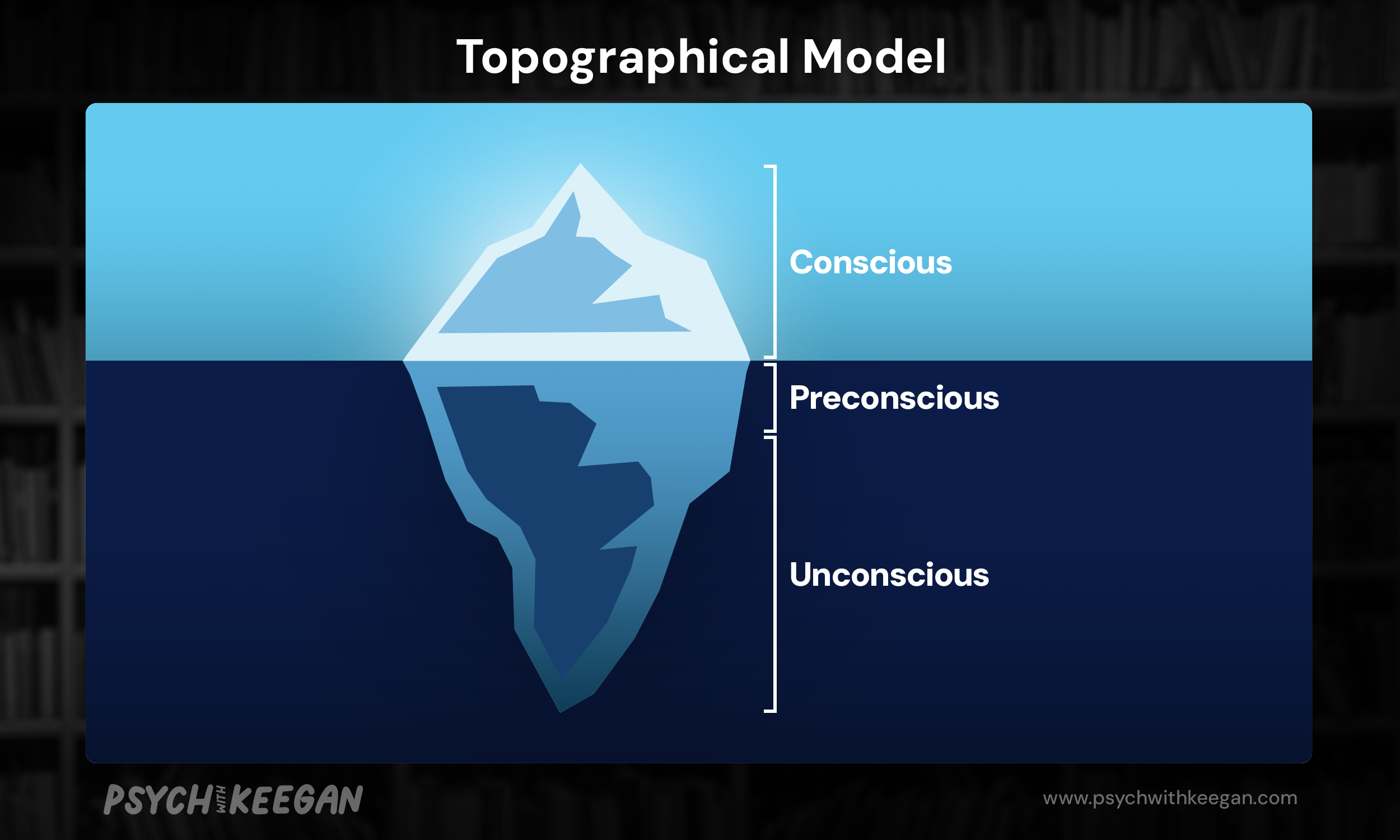
This model is often visualized as an iceberg, made up of three parts — one above the surface of the water representing our conscious mind. A second part just below the surface of the water, representing our preconscious mind. And finally, the third part, deep below the surface, being our unconscious.
Conscious Mind
Above the surface of the water, in the conscious mind, information is thought to be easily accessible. For the information in the conscious mind, our mind simply has to move its focus to that information and it’s there. The outside world can influence what conscious information our mind focuses on. And the information in our conscious mind can be fleeting—only there momentarily.
Preconscious Mind
The outside world is not the only influence on the conscious mind. Information can also come for the next layer, the preconscious. Freud believed the preconscious mind had one primary task, which was to protect the conscious mind. Positioned between the unconscious and the conscious, he thought the preconscious mind would censor information before it was sent to the conscious. For information in the preconscious, he believed it was able to quickly become conscious information. All our mind had to do was direct some energy toward the information in the preconscious, and that information could be sent to the conscious mind with minimal effort.
Freud hypothesized that the preconscious forms over time. As a person develops, and based on what happens in the world around them, this could influence how the preconscious mind would censor information for the conscious mind. Some believe that the preconscious is also where symptoms form. But more on that in a bit!
Unconscious Mind
Before we get to symptoms, let’s explore the unconscious mind. Freud believed that this was the most important area of the mind. Some also consider it to be the largest area—meaning that most information is kept in the unconscious.
Freud’s theory was that the unconscious held deep desires we hold. He thought that these desires could actually drive us to do things that would satisfy our unconscious desires, but that the way the unconscious went about this was disguised. In the mind, Freud believed there was a psychic energy that existed. In the unconscious mind, he thought this energy would flow freely. The energy was believed to be free flowing so that it could go where needed based on our unconscious desires at that time.
Freud developed this theory because of symptoms he was seeing in his trauma patients. He realized that the people he was working with who had experienced traumas would often not remember parts of the traumatic events. Based on this observation, he began to form his topographic model.
As part of the theory, he believed that when people experienced a sense of harmony, the boundaries between the unconscious, preconscious, and conscious would be more flexible. However, during times of conflict, these boundaries would become more rigid and defined. From this theory came the psychoanalytic concept of symptom substitution.
Symptom Substitution
Their belief was that unconscious drives would result in the physical manifestation of symptoms. They believed that only analytic techniques could truly address these symptoms. Furthermore, analysts thought that behavior change to address the symptom might stop that symptom, but the symptom would simply then become substituted with another symptom. Rosenthal gives the example of someone with a motor tic receiving behavioral treatment to reduce or stop the tic, then the person forming a habit of biting their nails—this being an example of symptom substitution.
Modern Research
But what does the research say about all of this? Since we just talked about the analytic concept of symptom substitution, I should mention a different version of this. There is a behavioral method of treatment for Tourette’s disorder and tic disorders that is based on symptom substitution. This treatment does have evidence supporting it being an effective treatment option. As for the psychoanalytic theory of symptom substitution, there is no strong evidence supporting this.
As for the rest of Freud’s theory on the conscious, preconscious, and unconscious mind, we see how these ideas have stuck around. Although they may not be used in exactly the same way as Freud had intended, the concepts of the conscious, preconscious, and unconscious mind remain today. Not only do we still use these terms, there is some research supporting processing that occurs at conscious and preconscious levels. As for the unconscious mind, there is no strong consensus, and instead, more debate about how it might function or if it exists at all. That said, Freud’s theory does not have wide support now. Freud himself moved on from this theory to later develop his structural theory of the id, ego, and superego.

If you or someone you know are needing immediate mental health assistance, please call or text 988, contact a local emergency telephone number, or go to the nearest emergency room.
By interacting with this website and channel, this does not constitute a therapist/client relationship. This content is intended for the purposes of entertainment and mental health education.
View additional disclaimers and notices on our Disclaimers page.


