
Donald Super is well-known in the area of career counseling. Previously, we discussed some of Super’s other theories, and now we’re expanding on that by going over his Life/Career Rainbow.
In Super’s Life/Career Rainbow, one of the key pieces of this is that he highlights the different roles people have throughout life. He identifies nine life roles:
I should add, leisurite is a term that Super coined. It is a role where the person’s primary pursuit is leisure activities and to have a more idle lifestyle.
Super recognized that people can have multiple roles at one time. For example, they can be a partner and a parent, while also being a citizen and a worker. He also recognizes that some people may never have some of the roles, such as never being a partner.
He also identified theatres, or areas where people play a role. Super had four theatres:
These theatres are where people play specific roles. For example, being in the student role at school, being in the worker role in the workplace, and so on. Sometimes, a role will be confined to one theater. For example, someone may be a worker and only ever do that in the workplace. However, there are also many times where a role may be played in more than one theatre. Such as a how a pupil will be in the student role at school, but can also be in this role at home while doing homework.
Role Conflict
When a role is played in more than one theatre, there is a chance for role conflict. A time where this could happen is if someone is in the worker role but needs to do someone for work while at home. If they usually keep work in the workplace (or workplace theatre), but then bring work home into the home theater, this can create that role conflict when the worker role is not usually played at home.
Expectations & Performance
Super believed that each role has expectations and performance that goes along with that role. Expectations for a role can be from other people, but can also come from the person in that role also. To say that another way, we might have expectations for ourselves when we are in a role (and what we expect from being in that role), and other people may have expectations for us in that role as well.
Performance has multiple components. This includes how satisfying the person in the role finds the role and how well they do at performing in that role. Another aspect of performance is how the role transitions over time and how this is managed. This transformation of a role is called role shaping.
Role Shaping
This role shaping occurs for multiple reasons. A common example of something that can cause role shaping is time. For example, the role of a child transforms over time as the person in the child role ages, but also as their parents age. Being the role of a child at age five is different compared to being in the role as a 25-year-old, which is still different from being in the role as a 45-year-old.
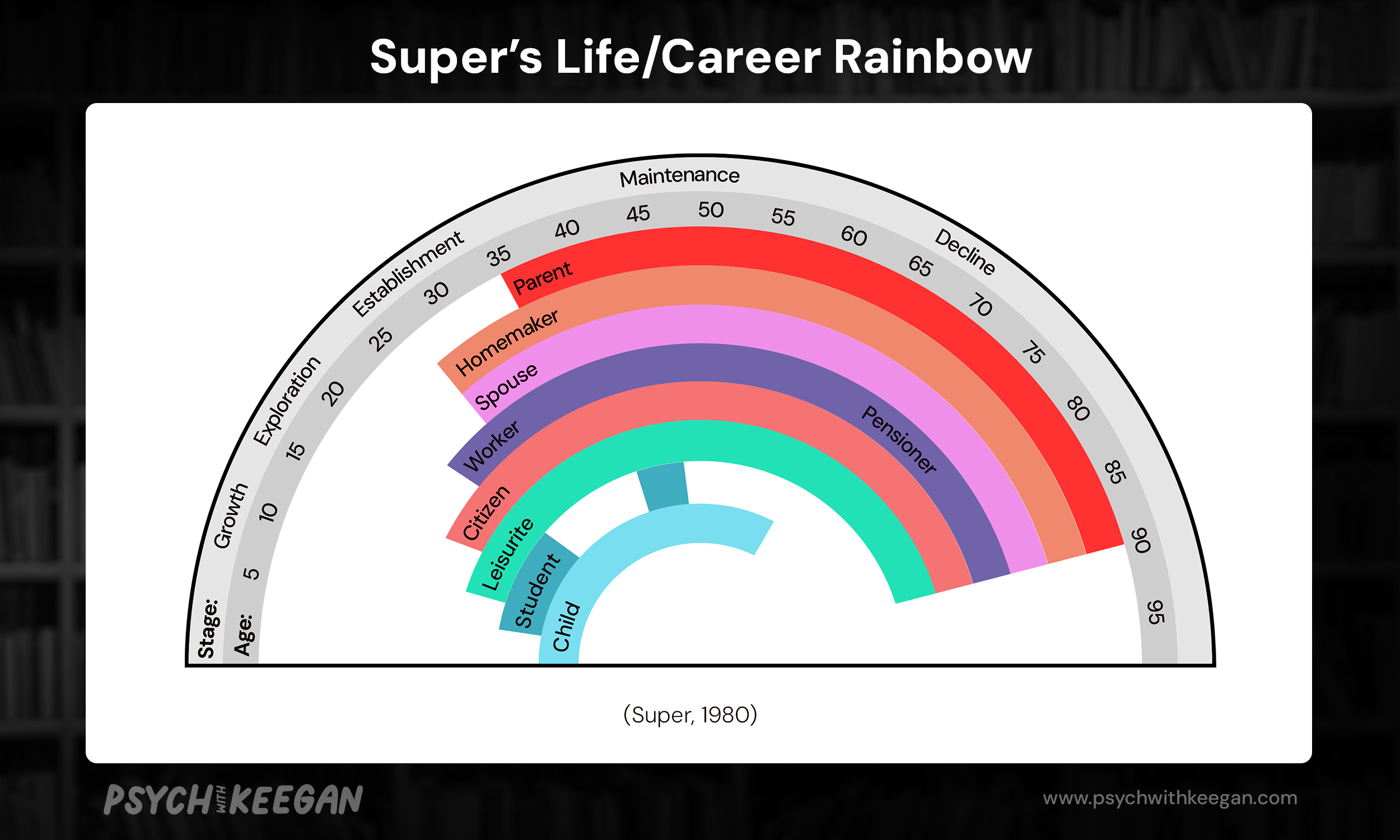
Now, let’s take a look at the visual representation of Super’s Life/Career Rainbow.
Outer Layers
When the Life/Career Rainbow is visualized, along the outer edge of the rainbow is usually where we see Super’s Career Development Stages. If you want to learn more about those, check out my past post and video on them. Along the out edge then, we see the stages of Growth, Exploration, Establishment, Maintenance, and Decline. Moving inward on the rainbow, the next layer depicts the person’s age.
Inner Layers
As we move inward, now we get to the various roles a person plays. Let’s start at the center-most layer, where we see the role of child depicted. Being a child is the first role to begin, which starts are birth. Roles don’t continue forever, so once a person’s parents have died, their role as a child is depicted as ending.
The next role to begin is that of student. With this role, we can see how someone may end this role, but pick it up again at a later point in life. This can happen with other roles as well.
This pattern continues, with each layer moving out, we see a new role added. Such as the role of leisurite, citizen, worker, spouse, homemaker, and parent.
Putting this all together, Super said this would tell the story of a person’s career. He called this their career pattern.



If you or someone you know are needing immediate mental health assistance, please call or text 988, contact a local emergency telephone number, or go to the nearest emergency room.
By interacting with this website and channel, this does not constitute a therapist/client relationship. This content is intended for the purposes of entertainment and mental health education.
View additional disclaimers and notices on our Disclaimers page.


